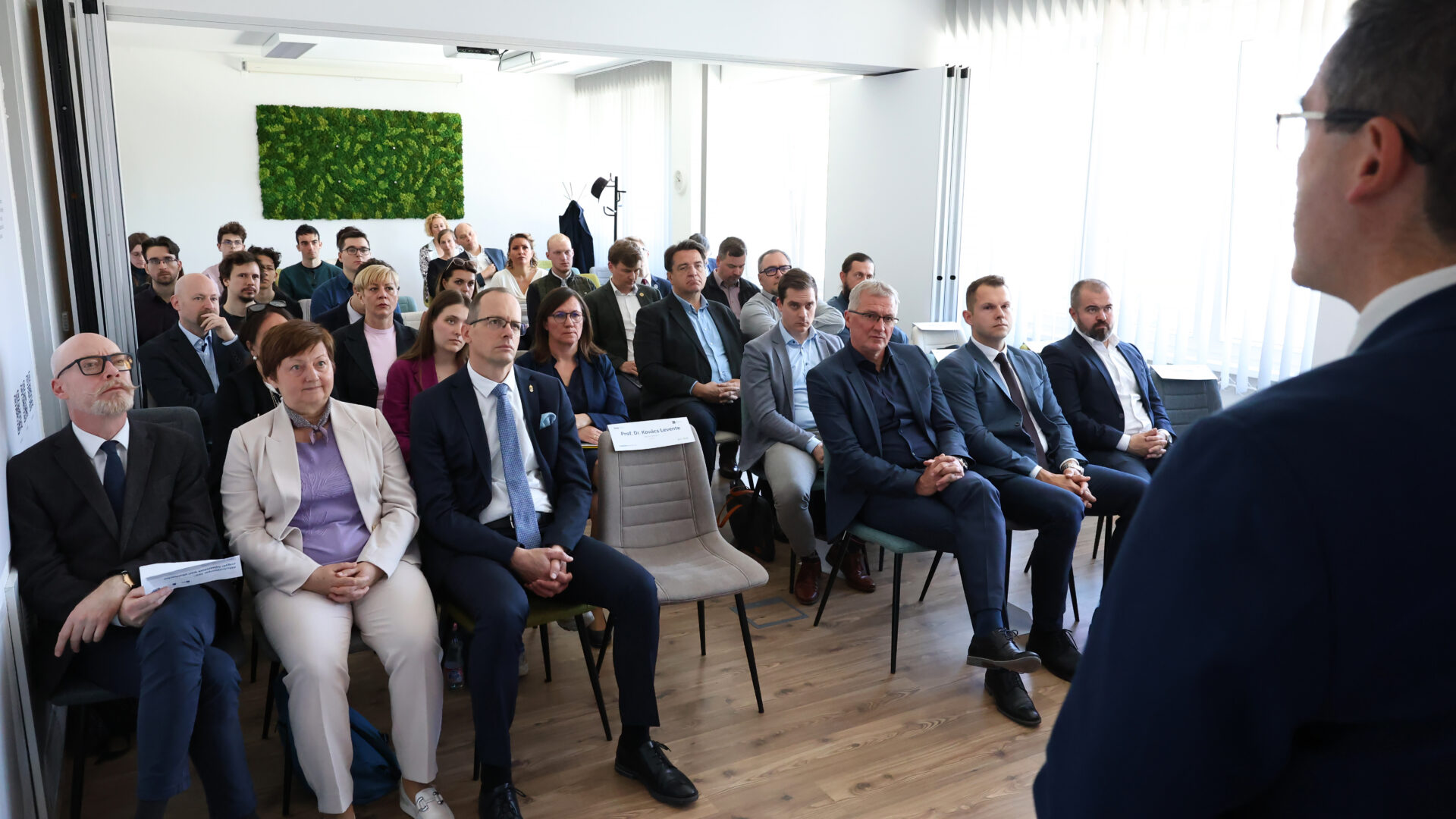


Óbuda University and the Bay Zoltán Research Center have signed a cooperation agreement.
The talent management-focused cooperation provides serious research and development opportunities for our most outstanding students, particularly those participating in the Excellence Óbuda scholarship program, while further strengthening our university's corporate network.

The agreement was signed on May 14 at the institute's headquarters in Budapest by Rector Prof. Dr. Levente Kovács and, on behalf of Bay Zoltán Research Center, Managing Director Dr. Balázs Schmidt, within the framework of the professional day titled 'Battery Industry 360° Program: Industrial Application of Hungarian Developments'.
During the program, our Excellence-scholarship students, who are deeply committed to research, development, and innovation, gained insight into the operations of the institute's primary research and development areas (materials technology, biotechnology, and industrial remediation). They also caught a glimpse of the institute's research infrastructure during laboratory visits, and were able to acquire more detailed information and new knowledge about the respective research fields through roundtable discussions.
 The main objective of the cooperation is for Óbuda University and the Bay Zoltán Research Center to mobilize their theoretical and practical knowledge bases in order to achieve their shared professional goals. Through this joint effort, combining the university's academic knowledge with the research center's professional experience, they aim to further elevate the standard of research, development, and innovation in Hungary,
The Bay Zoltán Research Center possesses internationally significant patents, research capacities, and excellent RDI experts; therefore, it serves as an ideal professional partner in supporting Óbuda University's talent management strategy, particularly in the successful implementation of the Excellence Óbuda Scholarship Program.
The main pillars of the cooperation include mentoring, joint project work in selecting TDK (Scientific Students' Associations), thesis, and dissertation topics, as well as professional networking and applied research."