

Schools of the Reform Era
In the early 19th century, Hungarian industry and the standard of industrial training lagged behind the more developed countries. Several of our predecessors made efforts to change these circumstances. Among them, Baron József Eötvös stands out as the intellectual founder of secondary industrial schools. As Minister of Religion and Public Education, he initiated the creation of a central model school in the capital for the training of foremen and supervisors for large-scale industry.
The work begun by József Eötvös was continued by Dr. Ágoston Trefort, Minister of Religion and Public Education, who founded the Budapest State Secondary Industrial School in 1879, in addition to establishing several other institutions.
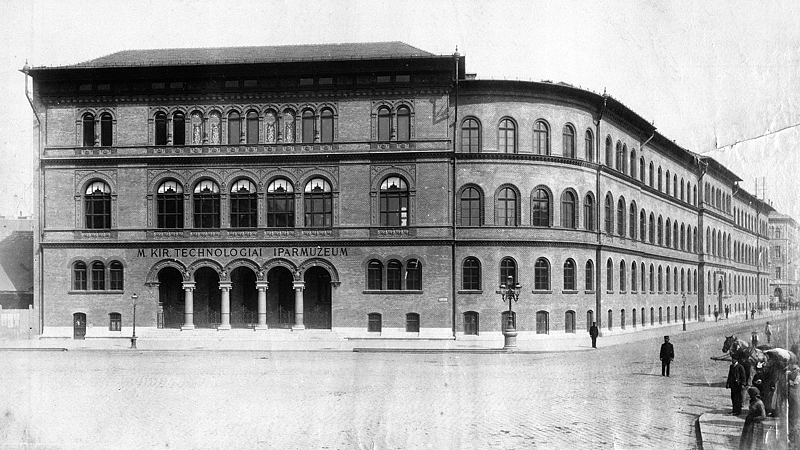
Dr. Trefort also established another institution that had a significant impact on the industrial development of Hungary and on the life of the school: the Technological Industrial Museum. After the initial operation of the two institutions, Trefort brought the museum and the industrial school into an organic relationship, appointing the director of the industrial school, Károly Hegedűs, as director general of the museum.
There was a demand to house the two institutions in a shared building, which became possible on the Grand Boulevard, behind the National Theatre building, on the site of a former fire station. Here was built—according to the chronicler of the Pesti Napló—Hungary’s palace of industrial affairs, the new home of the Central Industrial School and the Technological Museum.
Following curriculum modifications in 1896 and changes in the organizational regulations, the school received the title of Royal Hungarian State Higher Industrial School. According to the first paragraph of the regulation:
‘…its aim and task is to train mechanical engineers, chemists, supervisors, foremen, and in general such specialists for the domestic manufacturing industry, transport companies, and agriculture, who in time may become independent craftsmen, heads of small industrial plants and factories; and further, to train independent masters in the branches of the metal and iron industry, as well as in the wood industry areas covered by the curriculum.’
In 1898, the Royal Hungarian State School of Mechanics and Watchmaking was established. The goal of this secondary vocational school was to produce skilled workers, assistants, and independent craftsmen for the watchmaking and mechanical industries, and thereby develop the Hungarian watchmaking and mechanical industries and spread the professional knowledge necessary for their modernization. The school began operating in a rented building at 26 Kisfaludy Street in Budapest’s Józsefváros district.
The facilities on Kisfaludy Street were very limited, so in 1901, the Ministry of Trade and the Capital City of Budapest commissioned the construction of a new school at 15 Tavaszmező Street, based on plans by architect Gyula Pártos. A marble plaque in the entrance hall of the building informed future generations of the founders.
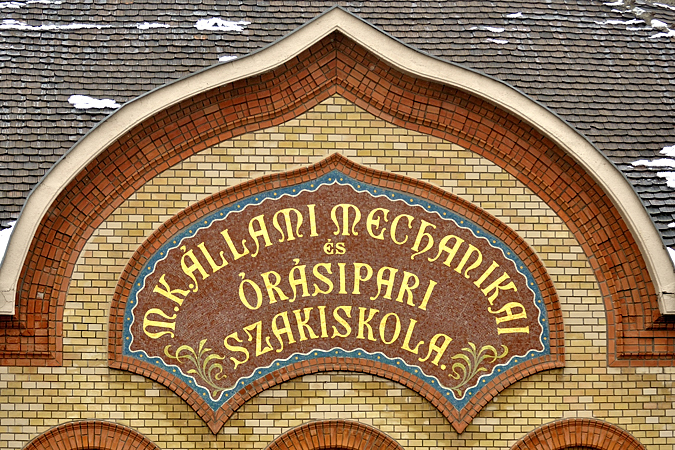
On its main façade, in the beautifully arched glass mosaic, the following inscription in Art Nouveau lettering can still be read today: Royal Hungarian State School of Mechanics and Watchmaking.
In the 1920/1921 academic year, the name of the school was changed to Royal Hungarian State School of Mechanics and Electrical Industry, reflecting the increasing focus on electrical engineering. It thus became the first institution in Hungary to include the word ‘electrical’ in its name.