


AI Ambassadors Lead Obuda University’s AI-Native Transformation
At AI Summit 2026, Rector Prof. Dr. Levente Kovács presented Obuda University’s AI-native strategy, which places artificial intelligence at the heart of teaching, research and operations. He explained why most of the work is about people rather than technology, and how AI Ambassadors, dedicated programs and the university’s own infrastructure are turning the strategy into everyday practice.
Rector Prof. Dr. Levente Kovács presented the strategy at AI Summit 2026, Central Europe’s largest AI conference, held in Budapest on 7–8 September. Being AI-native means that AI is not an add-on but the foundation of the university’s work, from curricula and research to administration.
“Around 70 percent of the work is about people: awareness, training and changing mindsets,” the Rector said. The first step is helping members of the university see AI as an opportunity rather than a threat, and creating an environment where they can experiment safely within clear rules.

To reach the whole community, the university is building a growing network of AI Ambassadors who share basic AI knowledge, organise forums and encourage colleagues to ask questions. “There is no such thing as a bad question,” the Rector said. Each faculty has designated ambassadors, supported by a university-wide network of AI Experts.
Students can join AI Squad, which is open to anyone interested in AI, or AI Core, a competitive, scholarship-based program for top performers. Everyone at the university takes part in a mandatory AI seminar, and the Lunch & Learn series offers short online sessions every second Wednesday on practical uses of AI.
The strategy covers four areas: AI in every curriculum, AI research, an ethical framework for responsible use, and AI-enhanced university services. The university is building a hybrid infrastructure with its own AI models, matching each task with the right tool. Solutions already in use include Help Mate, a chatbot that answers students’ questions about study regulations, AI tutors that students can create in the Learning Support System, and the OU Scientist research platform.
In the Rector’s view, Hungary’s competitiveness will not come from building large models to rival global players, but from targeted applications in strategically important industries, developed together with companies, startups and international partners.
Asked what a student will look like in ten years, he replied: “They should still have two legs and two hands, and a mind that can think critically.” Solid foundations in mathematics, physics and engineering help students judge what AI gives them, so that it becomes an accelerator of learning rather than a substitute for thinking.
More about the university’s AI program is available at ai.uni-obuda.hu.
People first
“Around 70 percent of the work is about people: awareness, training and changing mindsets,” the Rector said. The first step is helping members of the university see AI as an opportunity rather than a threat, and creating an environment where they can experiment safely within clear rules.
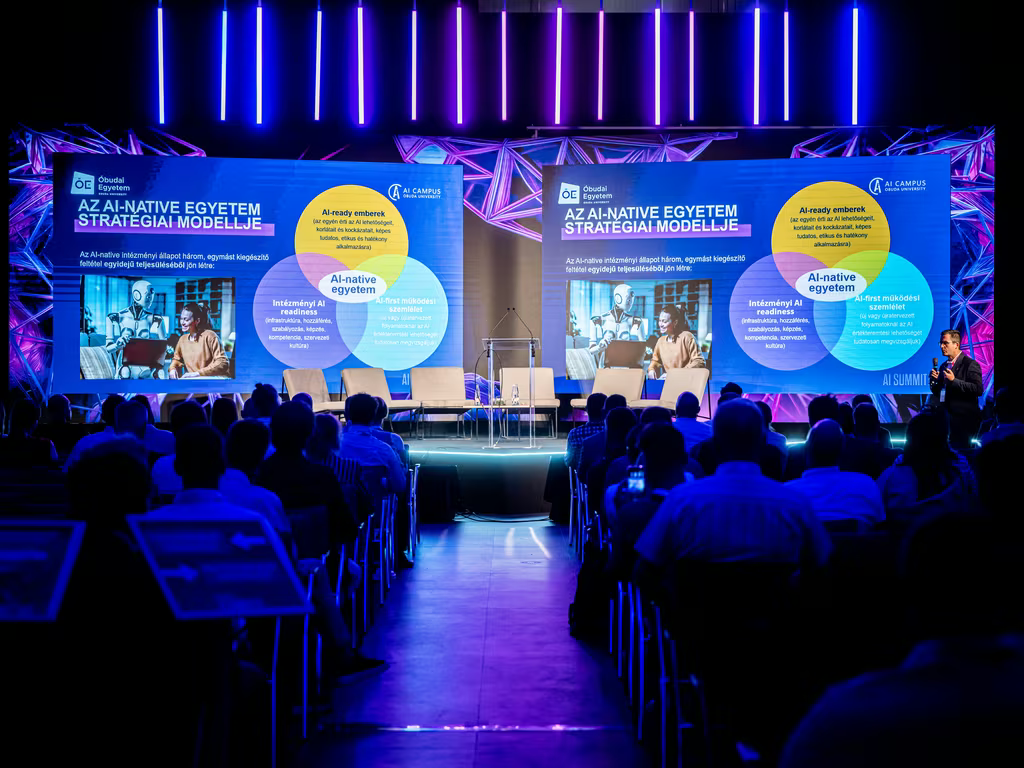
Photo: Index / Tövissi Bence
AI Ambassadors and programs for everyone
To reach the whole community, the university is building a growing network of AI Ambassadors who share basic AI knowledge, organise forums and encourage colleagues to ask questions. “There is no such thing as a bad question,” the Rector said. Each faculty has designated ambassadors, supported by a university-wide network of AI Experts.
Students can join AI Squad, which is open to anyone interested in AI, or AI Core, a competitive, scholarship-based program for top performers. Everyone at the university takes part in a mandatory AI seminar, and the Lunch & Learn series offers short online sessions every second Wednesday on practical uses of AI.
Infrastructure built for purpose
The strategy covers four areas: AI in every curriculum, AI research, an ethical framework for responsible use, and AI-enhanced university services. The university is building a hybrid infrastructure with its own AI models, matching each task with the right tool. Solutions already in use include Help Mate, a chatbot that answers students’ questions about study regulations, AI tutors that students can create in the Learning Support System, and the OU Scientist research platform.
Targeted applications and critical thinking
In the Rector’s view, Hungary’s competitiveness will not come from building large models to rival global players, but from targeted applications in strategically important industries, developed together with companies, startups and international partners.
Asked what a student will look like in ten years, he replied: “They should still have two legs and two hands, and a mind that can think critically.” Solid foundations in mathematics, physics and engineering help students judge what AI gives them, so that it becomes an accelerator of learning rather than a substitute for thinking.
More about the university’s AI program is available at ai.uni-obuda.hu.